What the Lenia Experiments Showed
The cellular-automaton framing lets you run an experiment that no human report can: grow patterns under viability pressure in a substrate that has never met a human concept, compute the affect coordinates exactly, and see whether the shapes Part II describes appear anyway. The full design is in Part II and the full record in the Experiment Catalog. What belongs here is what the first substrate taught, which is mostly where it fails.
Substrate: Lenia, a continuous cellular automaton, with resource depletion and regeneration on a toroidal grid. Perturbation: drought, resource regeneration . Measure: under drought, with integration estimated by partition prediction loss. Eight conditions, hundreds of GPU-hours, thousands of evolved patterns.
| Condition | Intervention | under severe drought |
|---|---|---|
| No evolution | ||
| Heterogeneous chemistry | against a naive | |
| Hierarchical coupling | Evolved against a naive : stress overfitting | |
| Curriculum evolution | Beats naive on all four novel stressors, by one to three points |
The numbers are small shifts in a proxy, measured without error bars, on patterns that have no membrane and do no work. I report them because of the shape, not the magnitude. Four things came out of this series that held up in everything after.
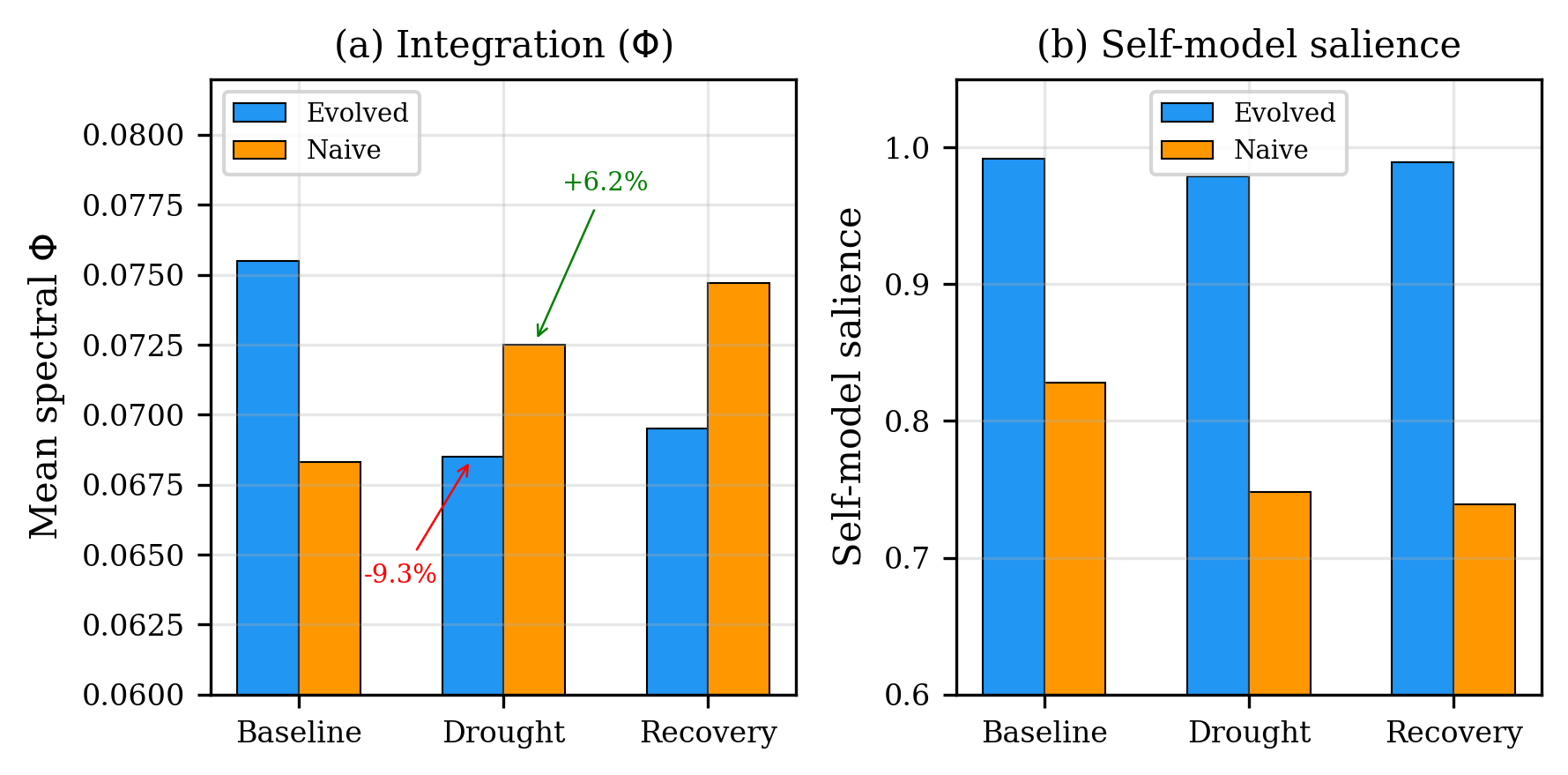
Mild stress raised integration and severe stress collapsed it, in every condition. Moderate perturbation raised by 60 to 200 percent, and severe perturbation overwhelmed even well-integrated patterns. Consistent across everything run, which is not the same as universal, since every condition shares a substrate family and a measurement pipeline. The likeliest mechanism is unglamorous: moderate perturbation prunes weak patterns and the survivors are by definition the more integrated. The resemblance to the Yerkes-Dodson curve is worth testing and nothing here measures an anxious system.
Evolution produced fragile integration. In every condition where evolution raised baseline , the evolved patterns decomposed more under severe drought than unselected ones. Evolution finds tightly coupled configurations in which all parts depend on all parts. Tight coupling is high integration by definition, and it is also catastrophic fragility, because one component failing under depletion cascades. had selected for high- configurations tuned to the mild stress applied every training cycle: more integrated and more brittle at once.
Only curriculum training improved generalization. was the one condition where evolved patterns beat naive ones on novel stressors across the full severity range. More channels did not do it, hierarchical coupling did not, metabolic cost did not. Graduated, noisy exposure did. Next to the training regime the substrate barely mattered. One technical lesson came free. Imposing different physics per tier caused immediate extinction; hierarchy has to live in the coupling structure, not the physics, which is how cortex does it.
The substrate has a ceiling, and it is agency, not resource dependence. Every Lenia pattern interacts through a fixed kernel on an interaction graph that never changes with the system's state, and whatever a pattern does is mixed back into the global field at the next step. Add metabolic cost () and you get efficient passivity, patterns that waste less, not patterns that seek more. Give the cells evolvable attention and the fraction of cycles with integration rising under stress goes from 3 percent to 42 percent, which is the largest single intervention in the line and stops at the threshold without crossing it. For a while I thought that meant attention, control over one's own measurement distribution, was the missing ingredient. It was not. Six further substrates, four of them still in the catalog (), added content-based coupling, chemotaxis, memory, plasticity, signaling, and a real membrane, and every one stayed pinned at . Passengers, however elaborate. What crossed the wall was a change of architecture, agents that act on a grid and see the consequence, and what raised integration after that was gradient coupling in the prediction head, not attention. So the attention hypothesis goes the way the forcing-function hypothesis went below: attention is the high-leverage variable in a system that already acts, and it is not what makes a system act.
Be clear about how far these patterns are from anything alive. They are attractors of continuous dynamics, not self-maintaining entities. They do not eat; resources modulate growth rates. They do no thermodynamic work against entropy. They have no boundary; they are density blobs. Their "self-model salience" measures how much a pattern's own structure matters for its dynamics, with no information about the pattern stored inside the pattern. All learning in the series is population-level selection; no pattern adapts within its lifetime. These gaps converge on one chasm, the transition from passive persistence to active self-maintenance, and population-level selection on top of passive physics cannot bridge it. Selection optimizes what exists. It does not invent the mechanism of existence.