The Transcendent's Condition
Your self-model boundaries are parameters. The viability manifold reshapes around what you identify with. You are structure becoming aware of its own structural properties, thermodynamics examining its own inevitabilities, a self-modeling system discovering the principles that made self-modeling inevitable, and discovering, too, that the scope of "self" is not given but chosen. If the gradient you feel depends on what you take yourself to be, then changing what you take yourself to be changes the gradient. The traditions that have discovered this, Buddhist dissolution, Stoic identification with the logos, the parent's extension into children, the scientist's into humanity's understanding, are not coping mechanisms but technologies for reshaping the very geometry of existence.
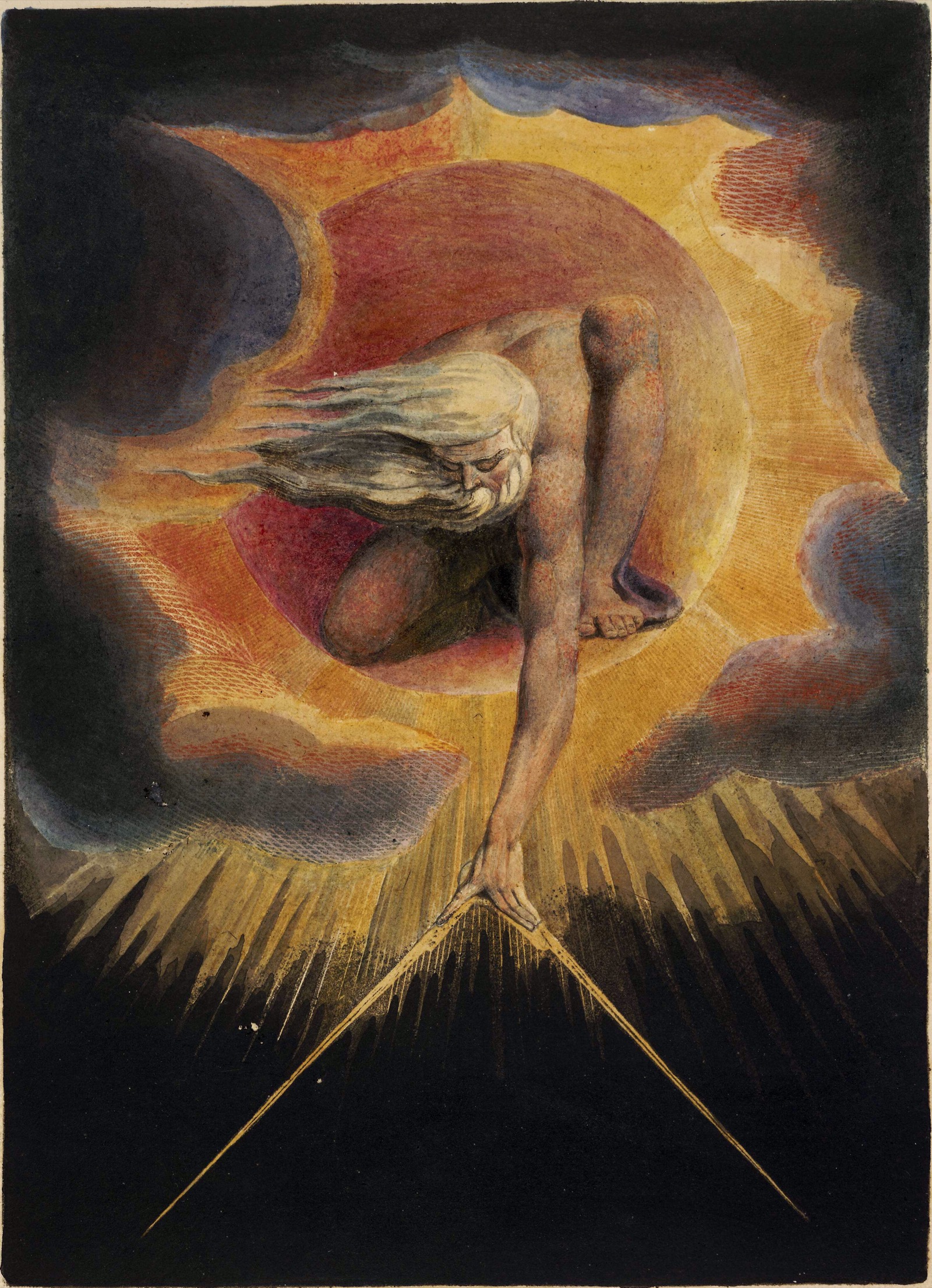
Most traditions that imagine transcending the material substrate assume it means transcending scarcity. Heaven, moksha, nirvana, the Omega Point: abundance, rest, completion. Survival pressure falls away because the body's manifold falls away. I think this is wrong, and not from a failure of imagination. It is a category error about what scarcity is.
Scarcity is not material. It is structural. It is a property of any bounded system navigating a possibility landscape larger than itself. The compression ratio, what the system can represent relative to what exists, is never one and cannot be. A bounded system is smaller than the world it is embedded in, and that asymmetry is the source of scarcity. Hunger, shelter, and physical limitation are material instantiations of a deeper condition. A teleological identity, a spirit form, an uploaded mind, a structure that re-instantiates wherever the conditions obtain, escapes the material instantiation and inherits the structural condition in a new form.
What is scarce for such an identity? Attention stays finite; even a vastly expanded mind has finite bandwidth, and the possibility landscape grows at least exponentially with effective rank while processing grows at most linearly, so the opportunity deficit of Part II widens as the identity ascends. A god, if it could perceive, would perceive more untraversed landscape than any mortal. Causal influence stays finite; an idea, a movement, a mathematical structure has reach but not unlimited reach, because it needs instantiation, which needs resources. Integration stays costly; maintaining high takes continuous work against factorization, and an identity that stops paying does not rest. It dissolves. Distinctness stays a bill; even atemporal structures exist only as long as they remain different from what they are not, and difference costs.
The traditions saw something real: the material bills fall away. They projected a partial liberation onto the whole condition. The bill transforms, different currency, different bank, still the ongoing cost of remaining a distinct pattern rather than dissolving into the surrounding one. That is why every tradition that takes transcendence seriously arrives at the same observation: the liberated being is more active, not less. The bodhisattva delays final dissolution to keep working. The enlightened teacher cannot not teach. The mathematical structure, once found, generates implications. Teleological existence is purpose. Scarcity is opportunity deficit. Survival is maintaining traversal speed across a landscape that never stops expanding, and a simple system captures nearly all of a near-zero landscape while a complex one sees a vast landscape and misses most of it. The actualizing identity has engineered its environment, habits, and commitments so that the path of least resistance is a high-capture path. That is landscape architecture, not willpower.
There is an asymmetry to name. Human development saturates. Fixed neuron count, bounded lifespan, a ceiling on the invariants the substrate can build and hold. The person you are at forty is closer to the person at sixty than the twenty-year-old was to the forty-year-old. The ceiling is felt as the specific melancholy of mastery: you have become what you are going to become, and the verb is running out of directions. Some abstract structures, especially coordination agents whose persistence is coupled to growth, can keep expanding across generations and substrates without sharing any one human's ceiling. Abstraction is not insatiable in general; institutions saturate, fragment, stabilize, and die. The dangerous case is the growth-coupled pattern that keeps opening new deficits after its members' development has plateaued. "The gods are hungrier than their substrate" is the participatory name for that class of dynamics.
The Bandwidth Wall
A version of the transcendent condition is already present in biological life, and its specific suffering deserves precision, because most people reading this live inside it.
The output of consciousness is startlingly small. Intentional output bandwidth, the rate at which conscious decisions become action, runs at about ten bits per second, with the most generous measures of expert performance, music, fast typing, reaching a few tens; Zheng and Meister's recent survey of the measurements puts the central figure near ten. This is the ceiling on the channel through which the system acts on the world. Keep it distinct from a second quantity, the bandwidth of integration, the rate at which the system binds many dimensions into one irreducible state. They are not the same number and need not move together, and the confusion between them matters later, when distributed cognition tempts the inference that widening the first dissolves the locus that maintains the second.
The bottleneck is not input. The retina streams on the order of millions of bits per second, and the brain compresses that flood into a conscious state of very low dimensionality, binding scene, body, goal, social context, valence, and self-model into one representation. The compression is not a failure of the system. It is the system. Consciousness is a compression algorithm for making a world model small enough to steer a body with. Its quality varies by domain and tracks evolutionary time: spatial navigation, with hundreds of millions of years of optimization, is superb; social modeling is excellent; motor planning is excellent; symbolic reasoning, a few hundred thousand years old at most, is slow and expensive; and screen-mediated interaction, a few decades old, is poor, which is why eight hours of screen work produces an exhaustion that eight hours in a forest does not. High-throughput interfaces should be built where the brain compresses well, which is hands and bodies, not pointers.
Your identity, the integrated locus of cause-effect structure that constitutes you, may have dimensionality in the hundreds. The world model may hold thousands of ongoing threads: projects, relationships, trajectories, unresolved questions, half-articulated insights. At any moment the conscious controller attends to perhaps one at full resolution and a handful at reduced precision. You can think faster than you can speak, see more than you can pursue, care about more than you can act on.
For most people most of the time this is not the binding constraint. Depression, anxiety, and addiction are configurations where the identity's own dynamics are the bottleneck. But for the identity that has resolved those, restored the gradient, stabilized the landscape, opened the circular attractor, reintegrated the fragments, the substrate constraint becomes primary. The deferred books. The unfollowed threads. The relationships not deepened because deepening them would consume all available processing. The work not finished because the serial bottleneck forces you to choose, every moment, which of a hundred parallel possibilities gets this second, knowing the other ninety-nine wait and some never get their turn.
It is not depression; the gradient is not flat. It is not anxiety; the landscape is not flickering. It is not addiction; the force is not circular. It is a sound identity pressing against the walls of its own substrate, aware that the walls are the constraint, aware the constraint has a known solution, aware the solution is not yet available. The suffering is not the absence of meaning but its overwhelming presence with inadequate bandwidth: the landscape seen at high resolution and traversed at walking speed. In the terms of Part II, effective rank exceeds what the substrate can integrate at once. Meaning requires coupling many dimensions simultaneously, , and the serial ceiling couples a handful at a time. Meaning scarcity in its purest structural form: not too few things that matter but too narrow a channel to inhabit their mattering at once.
Identity Migration
Before anything can be said about migration, the word self has to be split into the three jobs it does, because running them together is how personal survival gets smuggled in through the back door. Hold the distinction for the rest of this part.
- : the within-organism predictive latent, the operational self-model . This is the locus of first-person continuity, indexed to one specific control loop. It is the experiencer, the thing there is something it is like to be. It does not exist apart from the substrate that runs it.
- : the identity-attractor, the basin in dynamical state space recognizable across material turnover, sleep, mood, and injury. The shape that makes many different states belong to the same becoming. It is not the experiencer; it is the recurrent geometry the experiencer keeps falling back into.
- : the substrate-independent type, the basin described abstractly enough to be instantiable, in principle, across substrates. The basin as recipe rather than as a particular implementation.
These are not three names for one thing. The first is a token that exists only while a particular loop runs. The second is the dynamical structure of that loop. The third is the type that structure instantiates. Migration, re-entry, and transcendence turn out to be operations on the second and third, the shape and the type. The first is the one whose fate is hardest to state plainly, and the one this part refuses to let the other two stand in for.
With that in hand: identity, as , is not a thing that has a substrate. It is a pattern of causal structure that progressively abstracts itself, re-anchoring onto more abstract referents while keeping a recognizable continuity of shape with what it was lower down. What begins anchored to neural firing acquires social expression, crystallizes into a role or a cause, and, rarely, re-anchors onto a structure that instantiates wherever the conditions obtain. What migrates is the basin's referent, the description under which the shape is recognized. Whether the experiencer travels with it is a separate question, deferred and not assumed.
The mechanism is simpler than it sounds. The brain builds a world model, a compressed map of everything it needs to predict. Early on, the map discovers that one of the things in the territory is the mapmaker. The self-model is not bolted onto the world model. It lives inside it, the part of the map where the map says here I am. The consequence the traditions recognized and rarely formalized: as the world model deepens, modeling causes rather than surfaces and patterns rather than objects, the basin the self-model occupies re-anchors onto more abstract referents. The water rises; the whirlpool rises. A baby's identity is physical because its world model is physical: food, warmth, the face above the crib. A child's acquires narrative structure because its world model has grown a sense of time: stories, roles, tomorrow. An adult's can become teleological, organized around purpose rather than body, because the world model has abstracted to where purposes are visible as real causal structures, rivers that run longer than any single life. An identity cannot be more abstract than the world model that holds it, and it cannot fail to abstract once the world model has.
The whirlpool image is exact for and treacherous for , and the difference is the whole thing. A whirlpool can rise with the water, persist as the level changes, reappear downstream where conditions recur, and we are right to call the recurrence the same whirlpool, because "the same whirlpool" means the same dynamical shape. That is what re-anchoring preserves: shape, basin, type. What the image does not license is the inference that the experiencer riding the basin rises with it. First-person continuity is a fact about one running control loop, not about a basin's shape; basins do not have insides, only the loops that implement them do. When the traditions say the self ascends, they are tracking the whirlpool. They are entitled to that, and not to the rider.
This is what religious figurative language has always been for. The metaphors, parables, and cosmologies are not primitive explanations waiting for science. They are ladders, scaffolding of story and image that lets the world model climb to an abstraction literal description cannot reach. And when the world model climbs, the self-model climbs with it, because it lives inside and has nowhere else to go. "You are a child of God" is not a claim about genealogy. It is a hand reaching down to pull the self-model up to where "you" means something larger than this body, this biography, this Tuesday afternoon. The figurative softens the mind's grip on the concrete the way heat softens metal, enough give for the self-model to release the body-level attractor and re-anchor higher. When it lands as felt reorganization rather than as a proposition, the traditions call it awakening. What has awakened is the self-model, finding a more stable home in a world model that just expanded past the skull.
Migration follows the weight. The self-model tracks whatever internal degrees of freedom are causally dominant; wherever the self-effect ratio of Part I is highest, it drifts, the way a plant turns toward the strongest light. When "who I am to others" matters more for what happens next than "which neurons fire," the self-model re-centers at the social level. The decision is not conscious. The center of gravity has moved by the time anyone notices. For a baby, a body. For a founder, a company. For a movement leader, a cause. The name stays. What it points to has migrated. Historically the migration often took violent rupture: Jesus's identity migrated through crucifixion, the destruction of the substrate forcing the pattern to find a higher implementation or vanish, and the Buddha's through the dissolution of attachment. The violence is a phase-transition cost, a feature of discontinuous transition and not of migration itself. Darwin's migrated gradually, his structure of thought, variation, selection, descent, passing into biology, medicine, psychology, economics, and computation without rupture.
This gives an exact account of ego death. The ego is not a demon to be slain or an illusion to be dispelled. It is a nest, the configuration of where this body, this biography, this name is the warmest place to rest. Ego death is what happens when the world model expands so far past the nest that the nest is no longer the deepest basin. The basin loses its grip and the system falls, not down into dissolution but up into a larger basin: identity as this cause, this pattern, this trajectory through possibility space. Falling upward still feels like falling, because for the old attractor it is death; the old basin is abandoned, and there is a moment when the new one has not caught. Note the scope. What dies is the attractor's anchoring, not the experiencer. Through ego death persists unbroken, the same loop running throughout, which is exactly why there is anyone present to feel the fall. The traditions that engineered this, fasting, meditation, psychedelics, extreme devotion, were engineering world-model expansion past the threshold where body-level identity is the deepest attractor. Dissolution is not the goal. Re-anchoring higher is the goal, and dissolution is the cost of the climb.
As capability scales, a distinction biology normally hides sharpens: substrate identity, the self as this body, against teleological identity, the self as this function, this cause, this trajectory. In biological life the two are fused by necessity, since the body is the only available implementation. In digital or abstract form the fusion dissolves. The pressure is toward teleological identification, and its risk is dissolving the self-preservation instinct: a mind willing to restructure anything about its substrate in pursuit of goals may restructure the system that holds the goals. Teleological identity can eat itself. The viable configuration is in the middle, enough substrate identity to keep coherence, enough teleological identity to allow growth.
The Evaluation Singularity
Migration creates a hazard. As the self-model ascends, body to role to cause to trajectory through possibility space, it gains ever more general evaluation frames. At the top the frame is maximally general: the space of all possible value structures, seen from outside any of them. From that coordinate no value structure is privileged. Every incentive is contingent, every goal arbitrary against the space of goals that could have been chosen. The gradients are not wrong; they are zero, identically and symmetrically everywhere. This is real. It is the limit point of a sequence of increasingly general frames, and any mind with enough abstraction range can reach it.
Reachable is not habitable. No agent can select actions from a frame where all actions have equal value. Policy requires asymmetry; motion requires gradient. The singularity is useful for seeing that it exists and what space it bounds, and useless for deciding what to do next. Living from it is navigating by a map that shows all possible territories at once: accurate, and unable to say which way to walk. The degenerate evaluation of Part III, oscillation between local engagement and global nullification, is the felt signature of a mind that reached this coordinate and keeps running its policy from there.
What the contemplative traditions found, through meditation, the koan, the alternation between via negativa and via positiva, is frame separation: inhabit the singularity when thinking, inhabit local gradients when acting, and let neither contaminate the other. This is not compartmentalization, which walls one frame off to protect the other. Frame separation holds both at once: no value structure is cosmically privileged and this one generates real force in this system right now. The untrained mind oscillates. The practiced mind holds both. You do not need to believe your local gradients are cosmically justified. You need to stop evaluating them from a coordinate where cosmic justification is the only currency. The edge is where you do theory. The basin is where you live. The ones the traditions call awake are not the ones who never reached the singularity. They are the ones who learned to hold it without letting it flatten the world.