Work in Progress — This is an active research project. Content is incomplete, speculative, and subject to change.
Experiments
V13: Content-Based Coupling
V13: Content-Based Coupling
Substrate: FFT convolution + content-similarity modulation. Cells couple more strongly with cells sharing state-features.
Ki(j)=Kbase(∣i−j∣)⋅σ(⟨h(si),h(sj)⟩−τ)
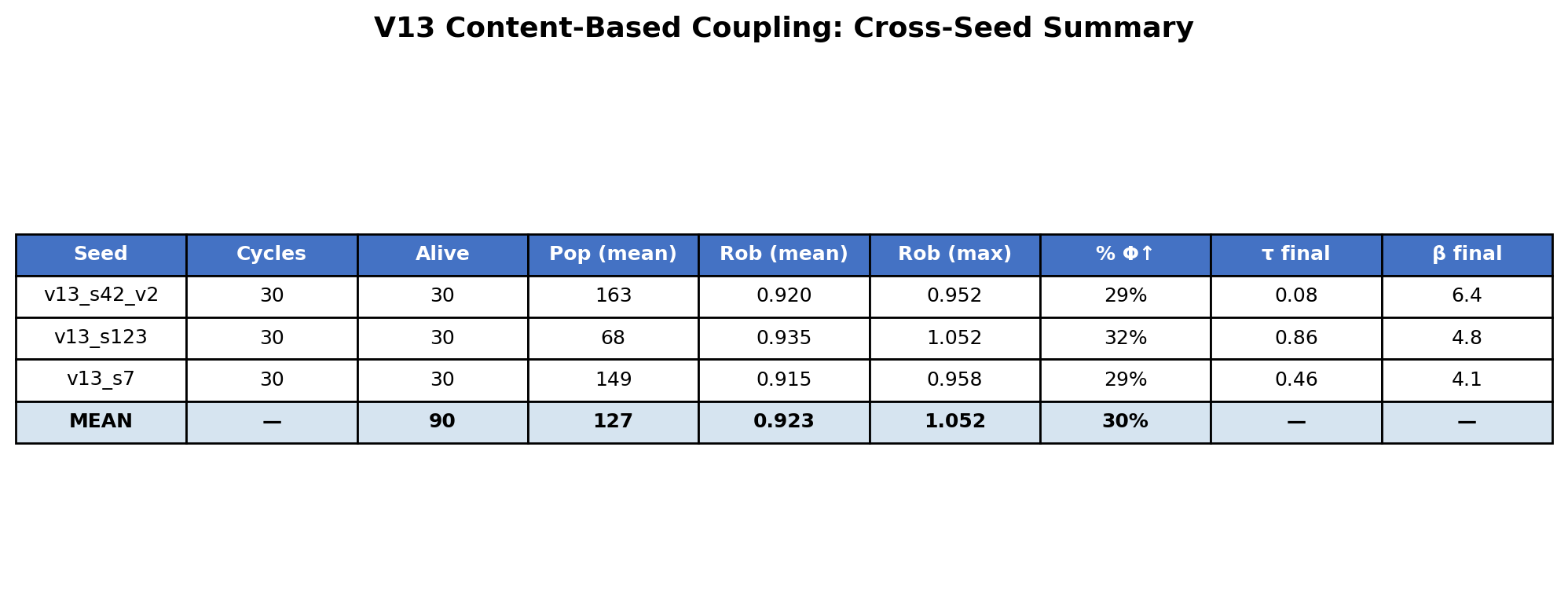
Three seeds, 30 cycles each (C=16, N=128). Mean robustness 0.923, peak 1.052 at population bottleneck. This became the foundation substrate for all measurement experiments (Experiments 0-12).
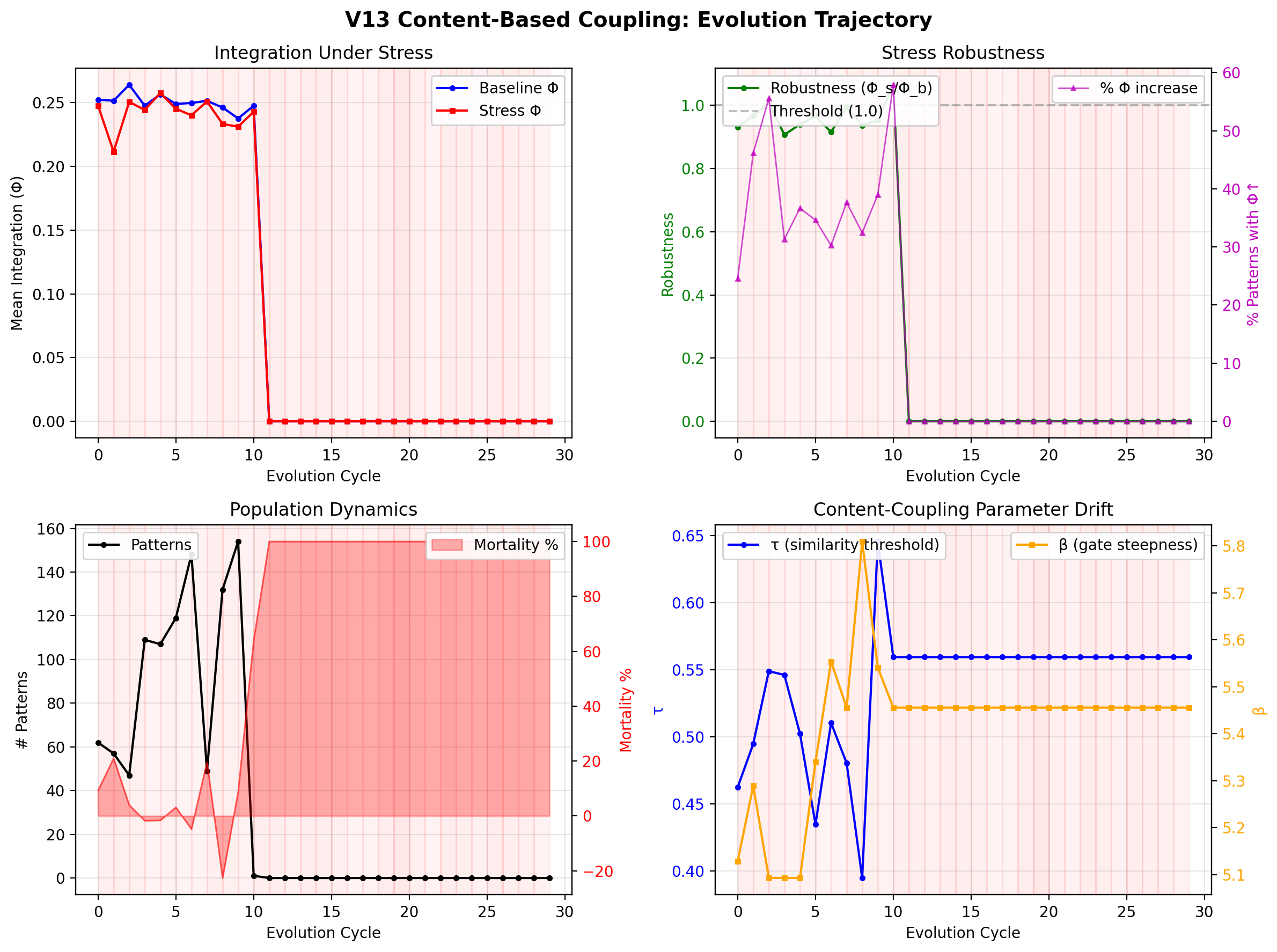
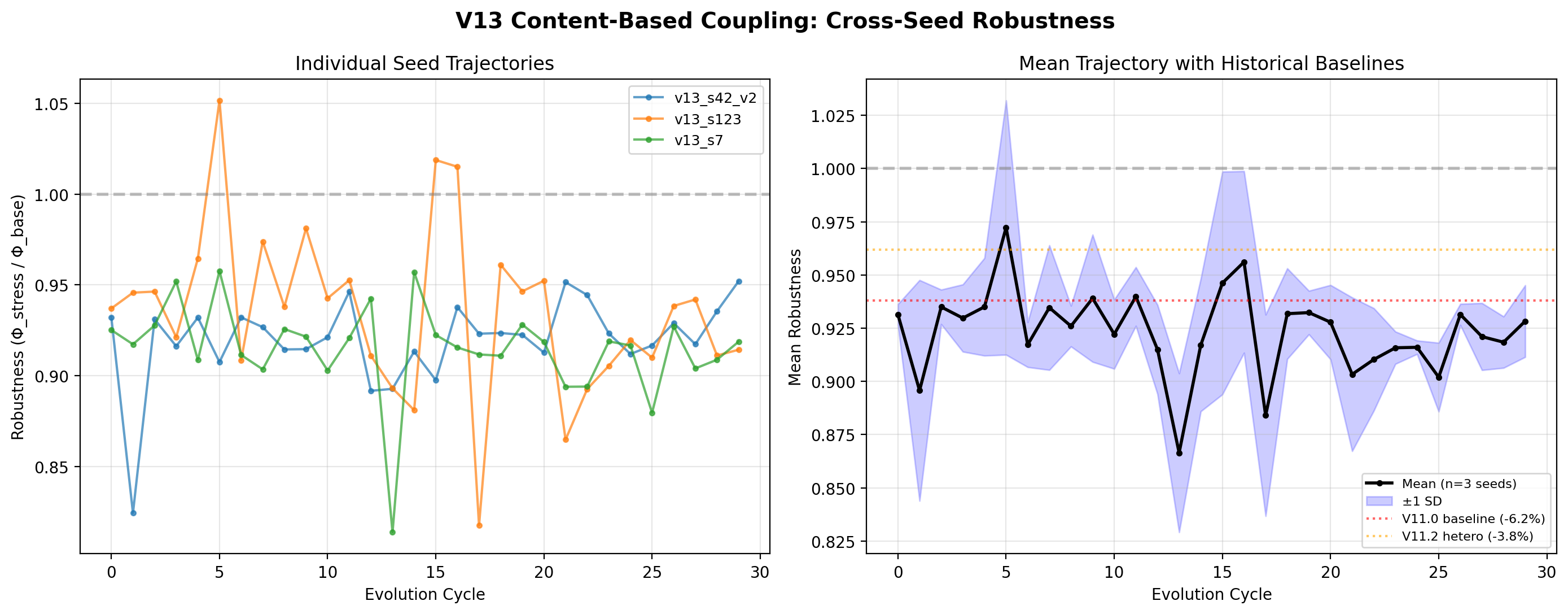
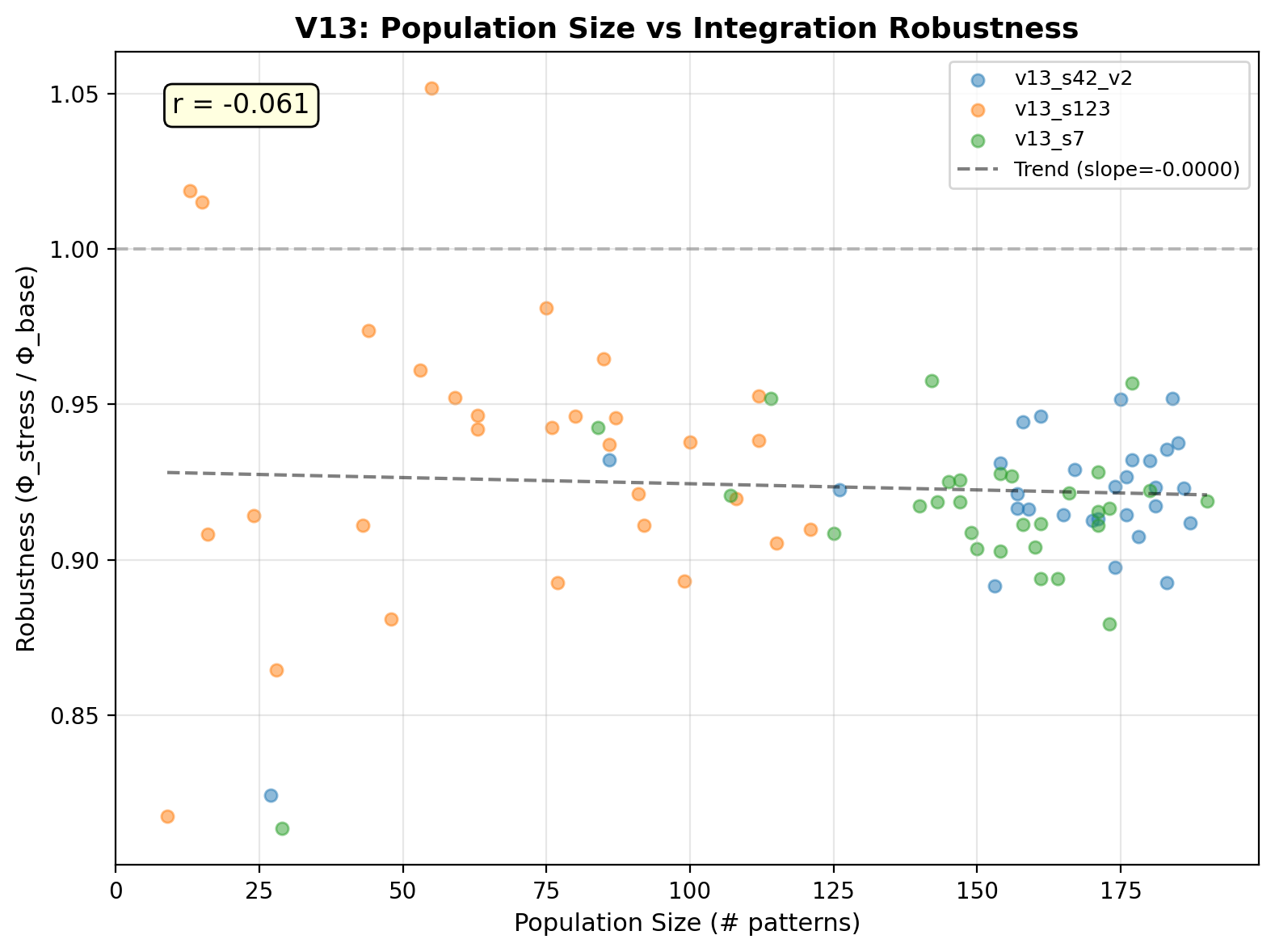
V13 evolution trajectory (seed 42). Four panels: (top-left) mean Φ under baseline and stress conditions — note the collapse to ~0 during severe bottleneck at cycle 10; (top-right) stress robustness with the proportion of patterns showing Φ increase; (bottom-left) population dynamics — the pink bands mark drought cycles with 60–100% mortality; (bottom-right) content-coupling parameters τ (similarity threshold) and β (gate steepness) drifting under selection.Cross-seed robustness trajectories. Left: individual seed trajectories (3 seeds, 30 cycles each) fluctuating around 0.90–0.95. Right: mean trajectory with ±1 SD band. Dashed lines show V11.0 baseline (−6.2%) and V11.2 heterogeneous chemistry (−3.8%) for comparison. V13 content coupling improves mean robustness but does not break the 1.0 threshold reliably.Population size vs integration robustness (r = −0.061). Each dot is one cycle from one seed. The flat trend confirms that integration robustness is a per-pattern property, not a collective emergent effect. Small populations (bottleneck survivors) occasionally show robustness above 1.0, but population size itself has no predictive power.Cross-seed summary. All 3 seeds survive 30 cycles. Mean robustness 0.923, with ~30% of cycles showing Φ increase under stress.