The Substrate Ladder
Seven substrate versions, each adding one capability, tracking whether evolution selects for it. The goal: build a substrate worth measuring.
V11: Lenia CA Evolution
Period: 2025-2026. Substrate: Continuous cellular automaton (Lenia) with evolutionary dynamics.
Versions: (naive), (homogeneous evolution), (heterogeneous chemistry), (hierarchical coupling), (curriculum training).
| Version | (drought) | Key lesson |
|---|---|---|
| (naive) | -6.2% | Decomposition baseline |
| (homogeneous evolution) | -6.0% | Selection alone insufficient |
| (heterogeneous chemistry) | -3.8% | +2.1pp shift from diverse viability manifolds |
| (curriculum training) | +1.2 to +2.7pp generalization | Only intervention improving novel-stress response |
Key finding: Training regime matters more than substrate complexity. The locality ceiling: convolutional physics cannot produce active self-maintenance under severe threat. The Yerkes-Dodson pattern (mild stress increases integration, severe stress destroys it) appeared in every condition — the most robust empirical finding across the entire program.
Source code
Study record — canonical metadata, result path, status, seeds, and key finding.
- — Lenia substrate with FFT convolution
- — Evolution loop with curriculum stress
- — CLI runner for all V11 variants
- — Affect measurement (Phi, robustness)
V12: Attention-Based Lenia
Addition: State-dependent interaction topology (evolvable attention kernels).
Result: increase in 42% of cycles (vs 3% for convolution). +2.0pp shift — largest single-intervention effect. But robustness stabilizes near 1.0.
Implication: Attention is necessary but not sufficient. The system reaches the integration threshold without crossing it.
Source code
Study record — canonical metadata, result path, status, seeds, and key finding.
- — Attention kernel implementation
- — Evolution loop
- — CLI runner
V13: Content-Based Coupling
Substrate: FFT convolution + content-similarity modulation. Cells couple more strongly with cells sharing state-features.
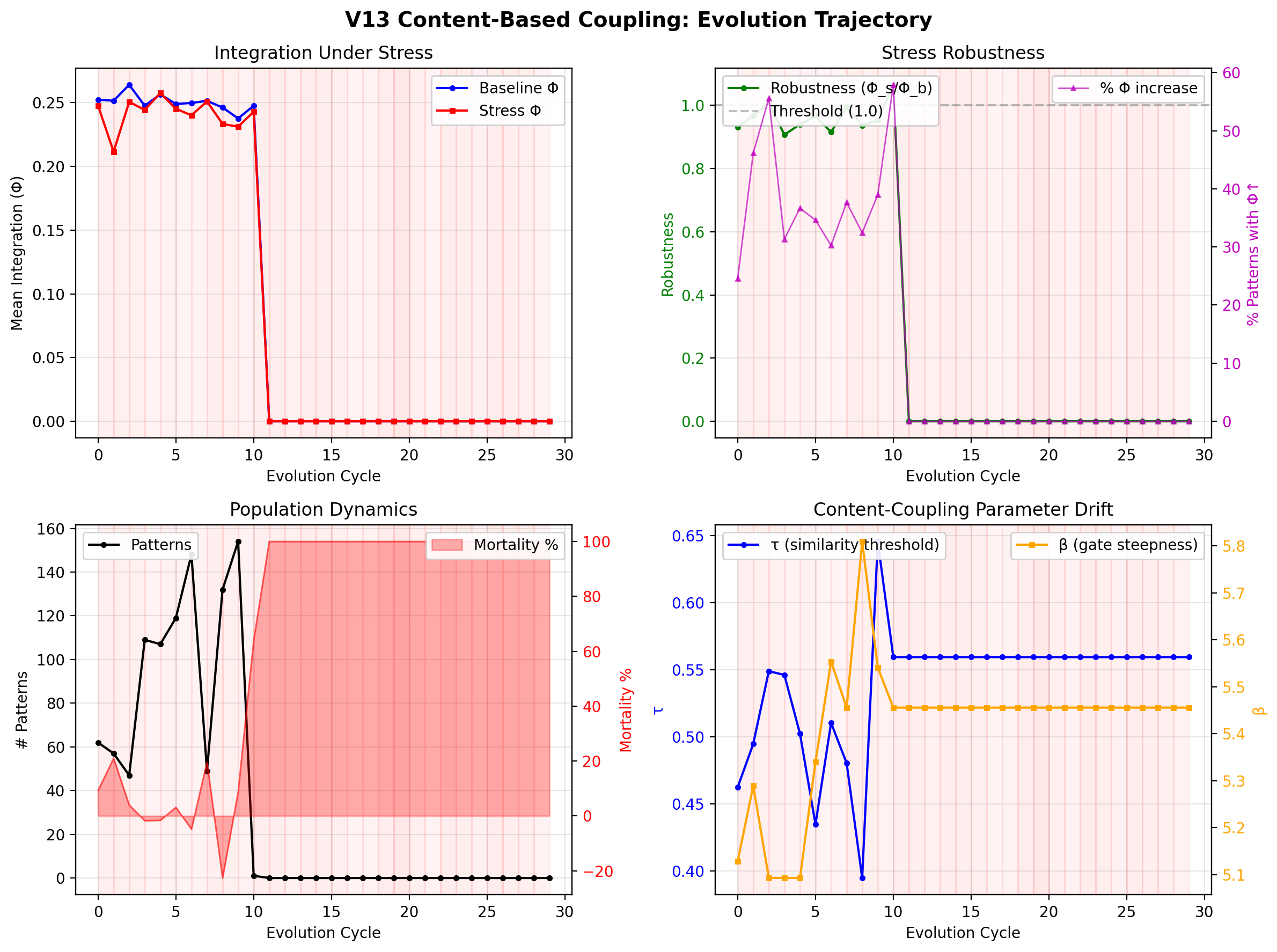
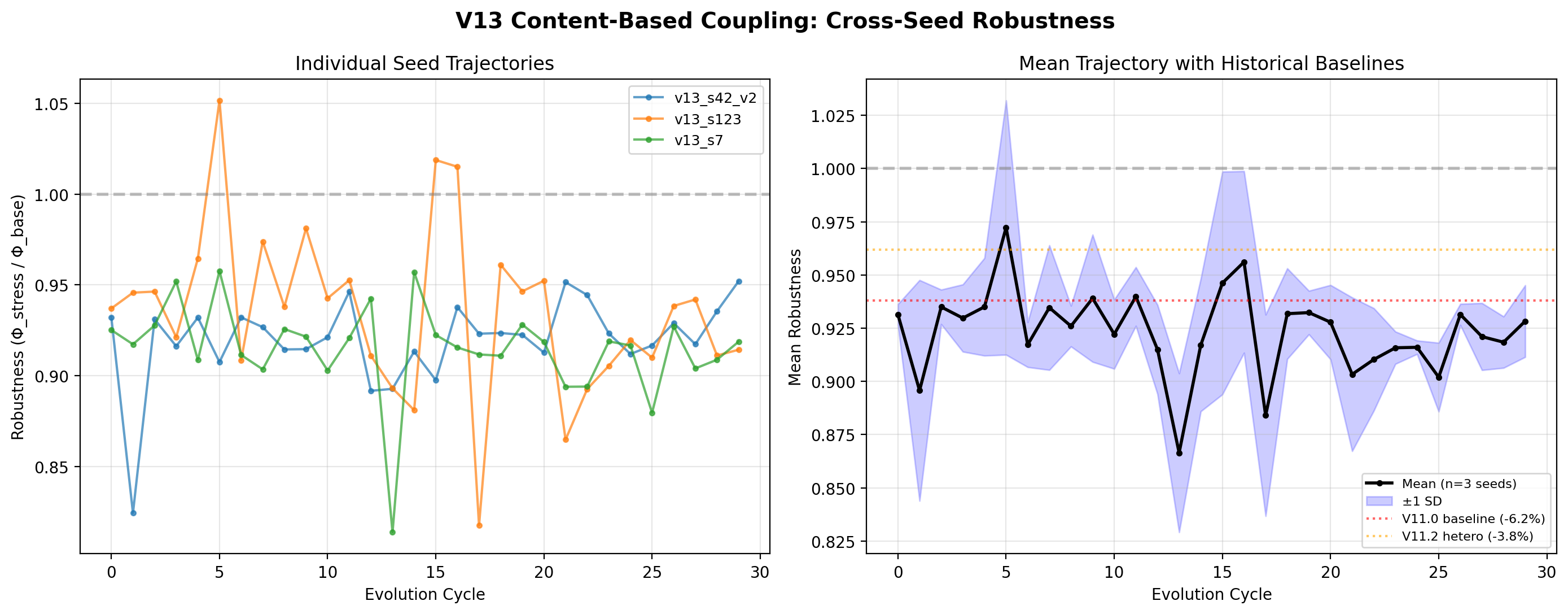
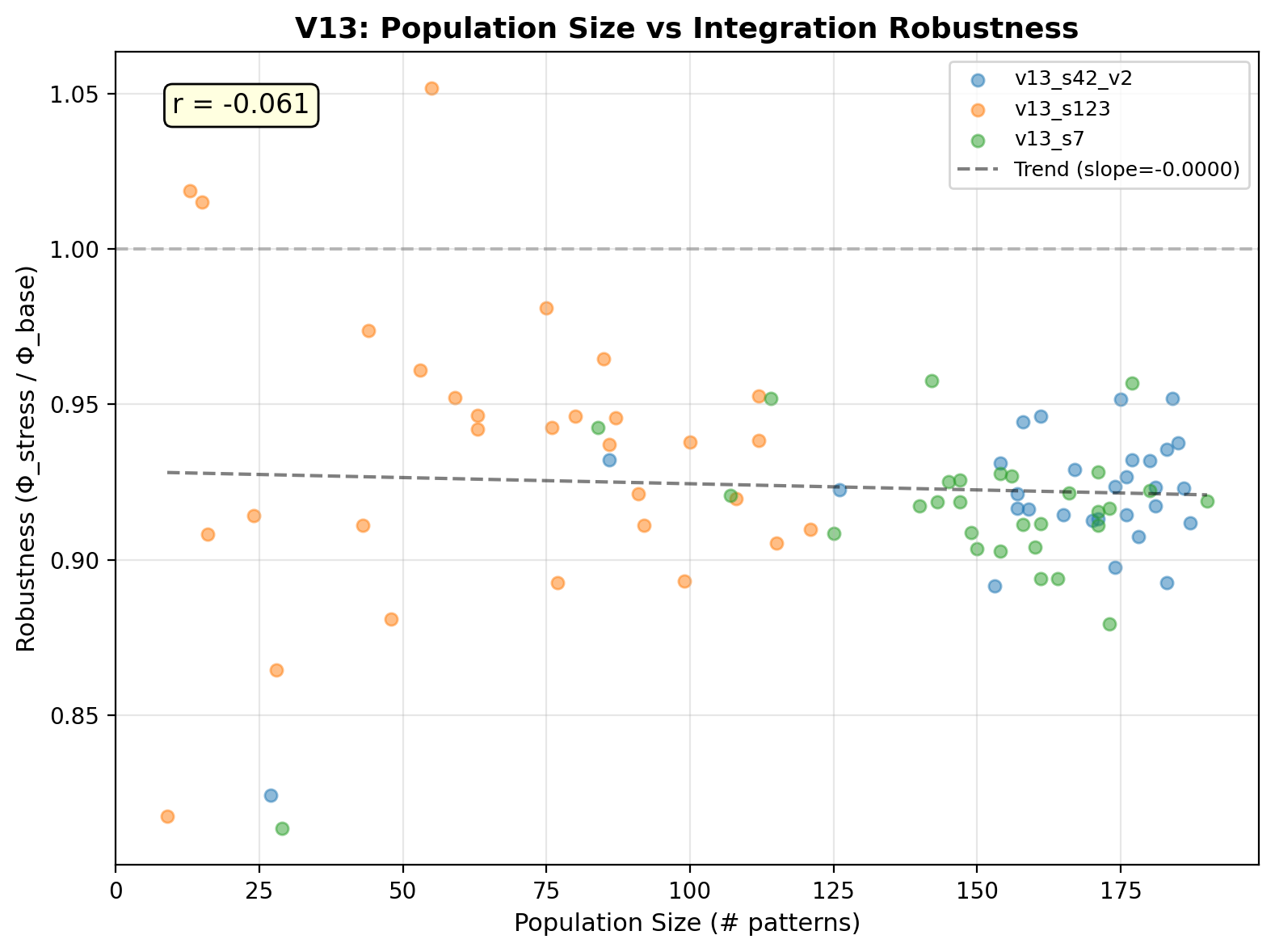
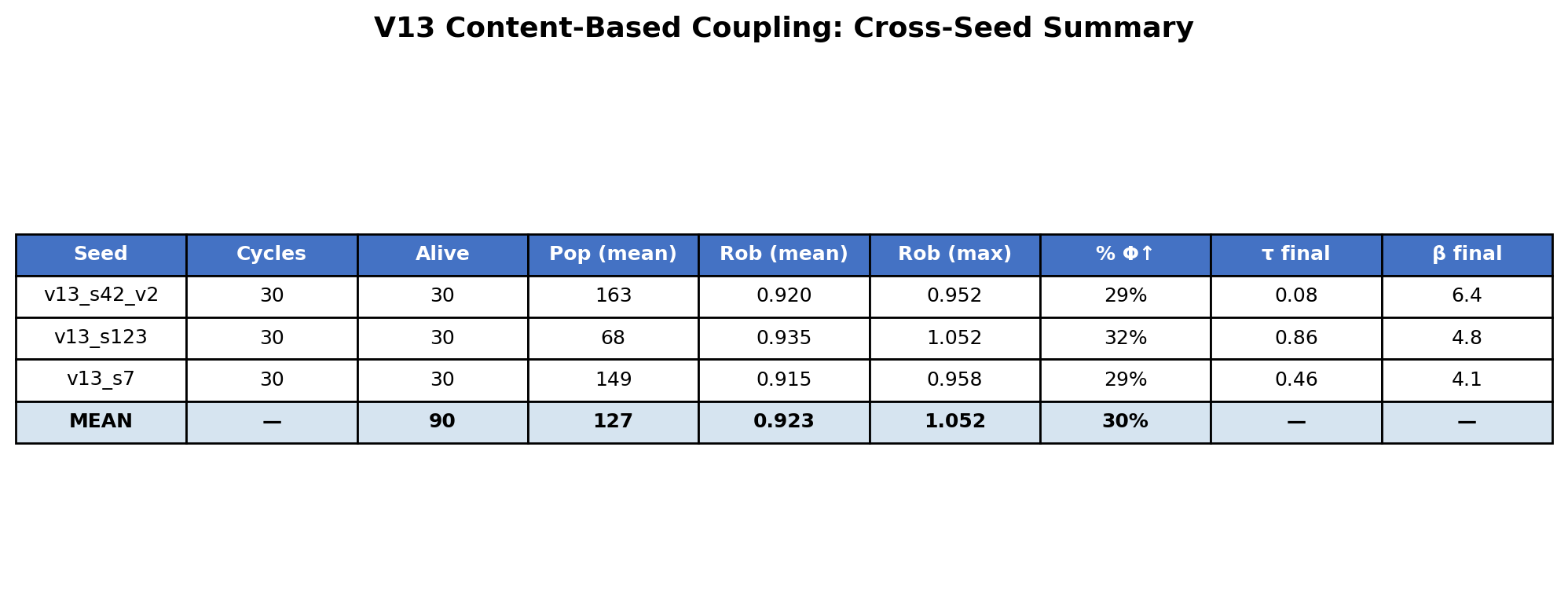
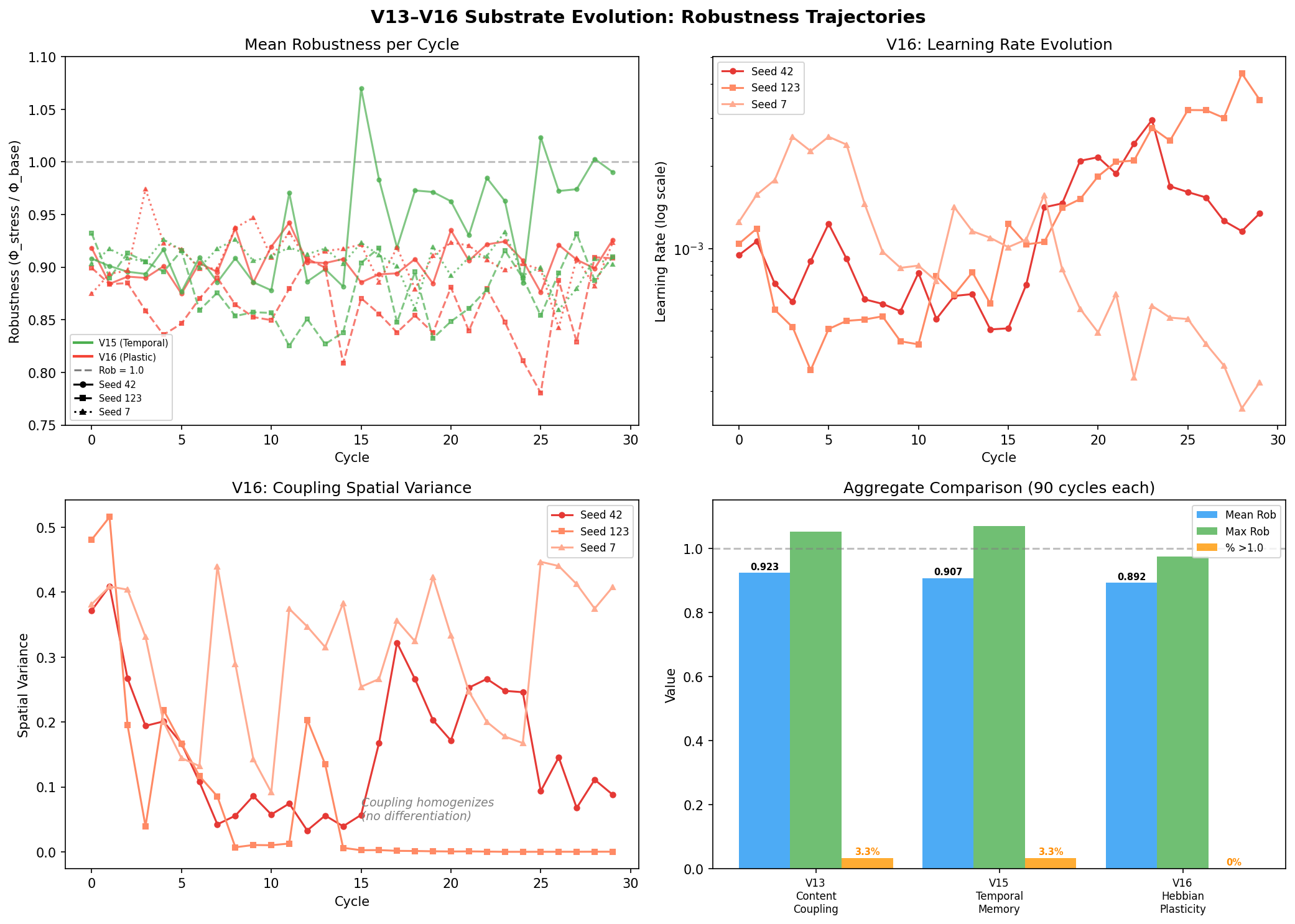
Three seeds, 30 cycles each (, ). Mean robustness 0.923, peak 1.052 at population bottleneck. This became the foundation substrate for all measurement experiments (Experiments 0-12).
Source code
Study record — canonical metadata, result path, status, seeds, and key finding.
- — Content-coupling substrate
- — Evolution loop with curriculum
- — GPU runner (Lambda Labs)
- — Cross-seed aggregation
V14: Chemotactic Lenia
Addition: Motor channels enabling directed foraging. Velocity field from resource gradients gated by the last two of channels.
Result: Patterns move 3.5-5.6 pixels/cycle toward resources. Motor sensitivity evolves. Robustness comparable to (~0.90-0.95).
Source code
Study record — canonical metadata, result path, status, seeds, and key finding.
- — Chemotaxis implementation
- — Evolution loop
- — GPU runner
V15: Temporal Memory
Addition: Two exponential-moving-average memory channels storing slow statistics of the pattern's history. Oscillating resource patches reward anticipation.
Result: Evolution selected for longer memory in 2/3 seeds — memory decay constants decreased 6x. Under bottleneck pressure, stress response doubled (0.231 to 0.434). Peak robustness 1.070.
Temporal integration is fitness-relevant. This was the only substrate addition evolution consistently selected for. Memory channels help prediction (~12x vs ) but don't break the sensory-motor wall.
Source code
Study record — canonical metadata, result path, status, seeds, and key finding.
- — EMA memory channels
- — Evolution with memory tracking
- — GPU runner
- — Measurement re-runs on V15
V16: Hebbian Plasticity
Negative result. Mean robustness dropped to 0.892 — lowest of all substrates. Zero cycles exceeded 1.0.
Addition: Local Hebbian learning rules allowing each spatial location to modify its coupling structure in response to experience.
Lesson: Simple learning rules are too blunt. The extra degrees of freedom overwhelm the selection signal. Plasticity added noise faster than selection could filter it.
Source code
Study record — canonical metadata, result path, status, seeds, and key finding.
- — Hebbian plasticity implementation
- — Evolution loop
- — GPU runner
V17: Quorum Signaling
Addition: Two diffusible signal fields mediating inter-pattern coordination (bacterial quorum sensing analog).
Result: Produced the highest-ever single-cycle robustness (1.125) at population of 2. But 2/3 seeds evolved to suppress signaling entirely.
Lesson: Signaling is costly in large populations, beneficial only at extreme bottlenecks.
Source code
Study record — canonical metadata, result path, status, seeds, and key finding.
- — Quorum sensing fields
- — Evolution loop
- — GPU runner
V18: Boundary-Dependent Lenia
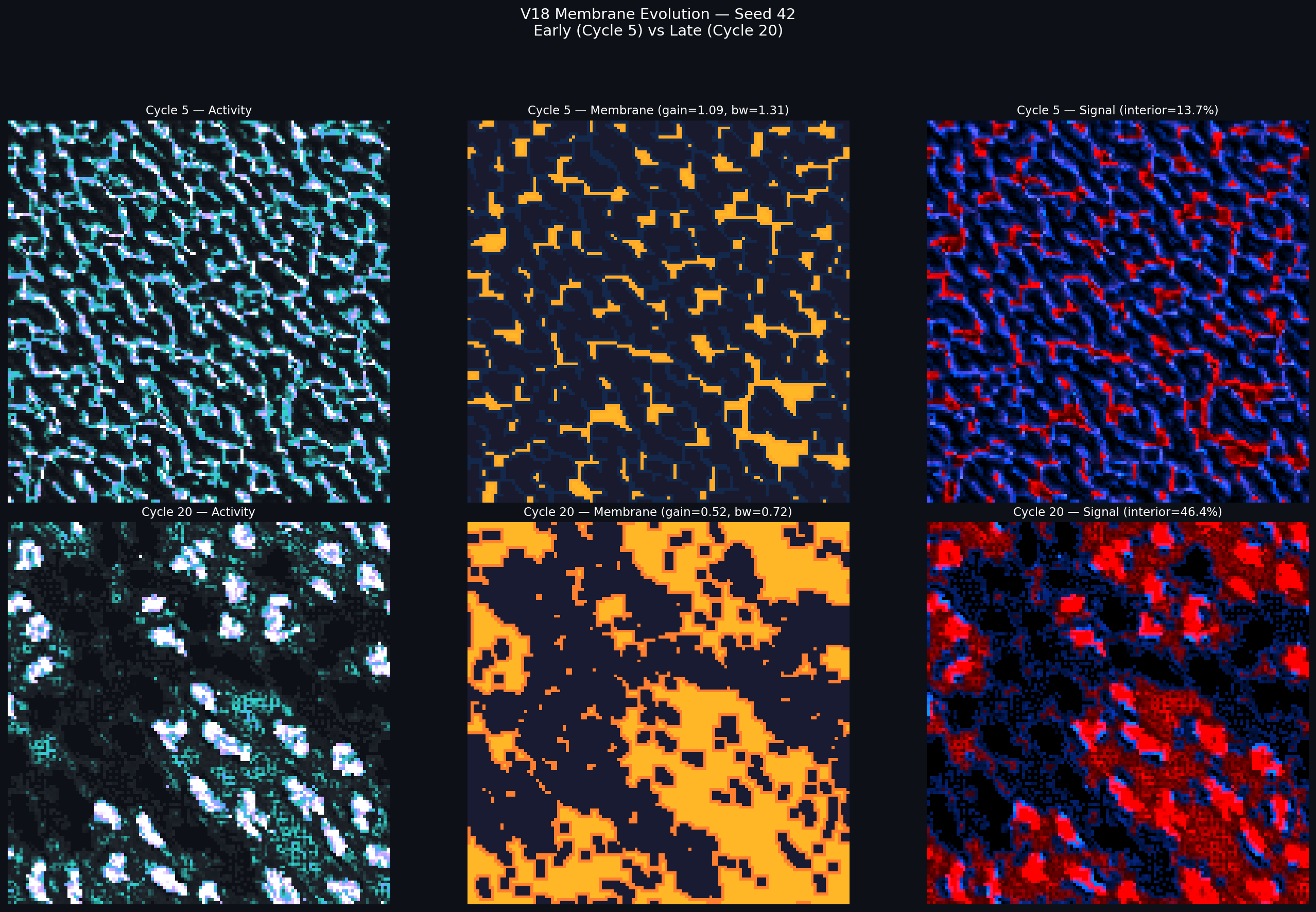
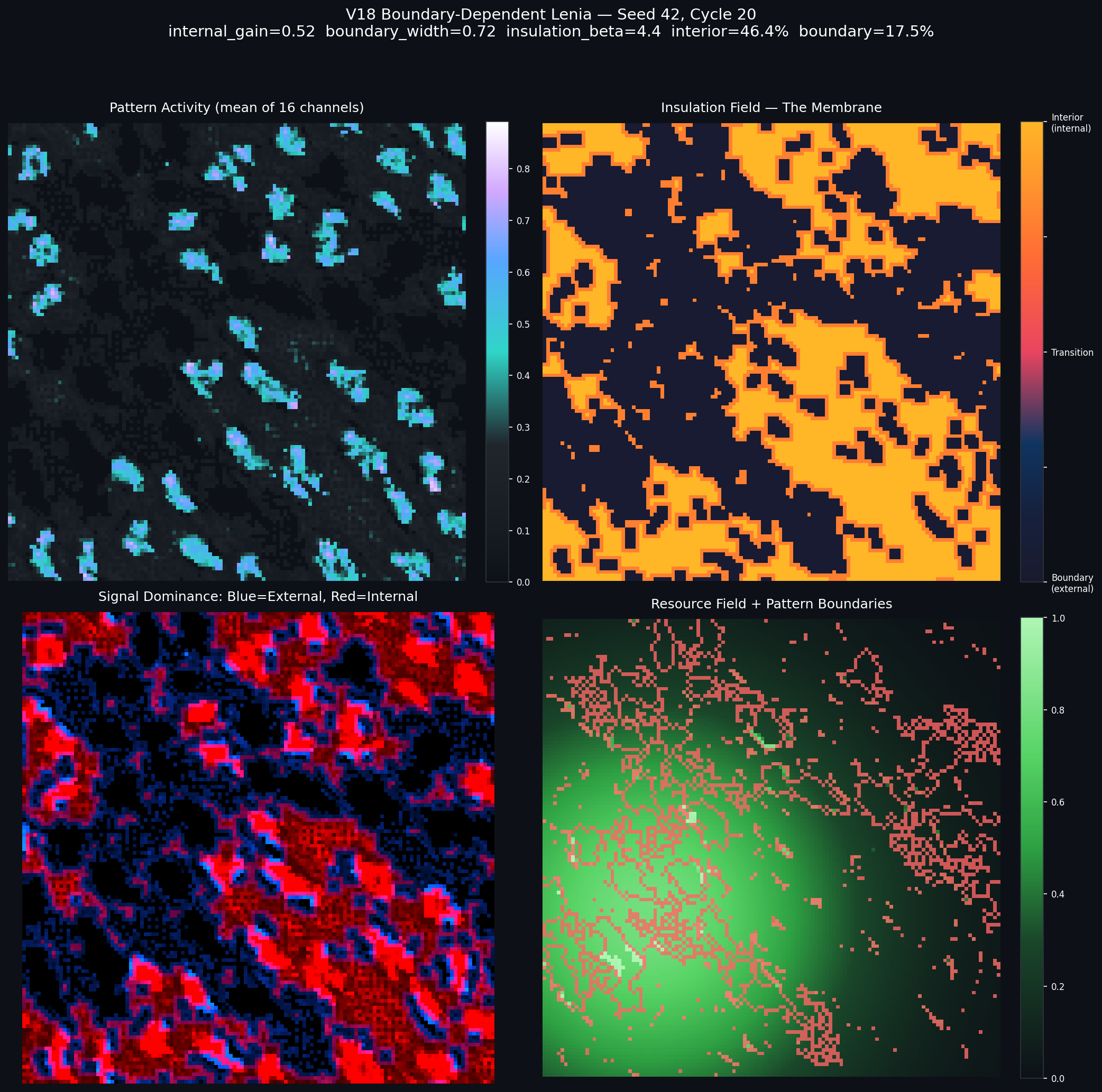
Addition: Insulation field via iterated erosion + sigmoid creating genuine boundary/interior distinction. External FFT signals gated by , internal short-range recurrence gated by .
Three seeds, 30 cycles. Mean robustness 0.969 — highest of any substrate. Peak 1.651 (seed 42). 33% of cycles show increase under stress.
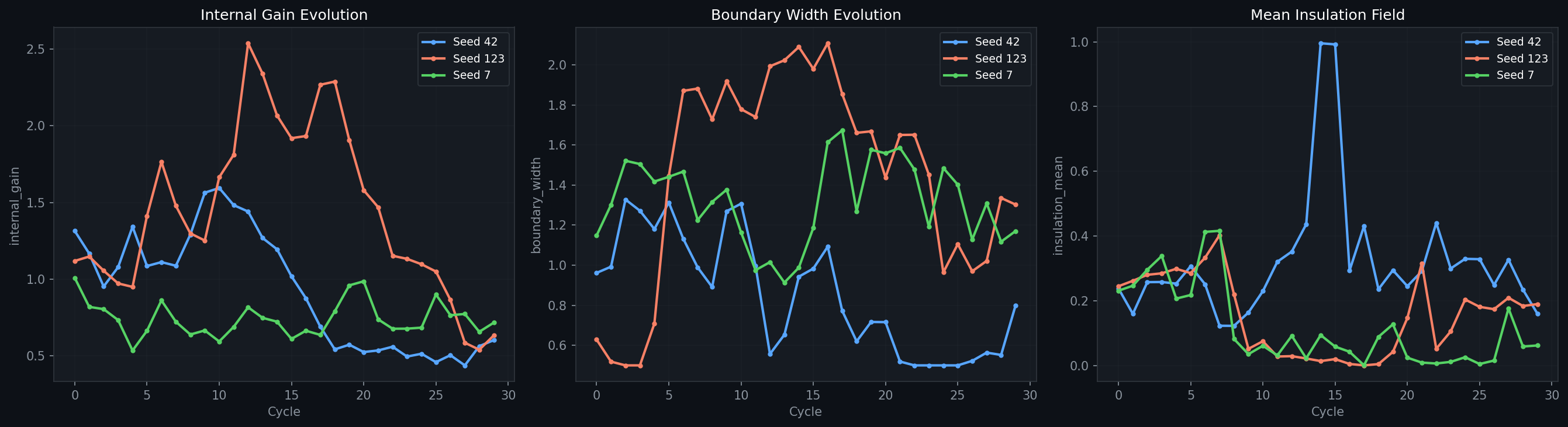
Surprise: internal_gain evolved down in all three seeds (1.0 to ~0.6). Evolution preferred permeable membranes over insulated cores. External sensing was more valuable than internal rumination.
Verdict: Best engineering result (highest robustness) but not the theoretical goal (breaking the coupling wall).
Source code
Study record — canonical metadata, result path, status, seeds, and key finding.
- — Boundary-dependent dynamics
- — Evolution loop
- — GPU runner
- — Measurement re-runs on V18
Cross-Substrate Summary
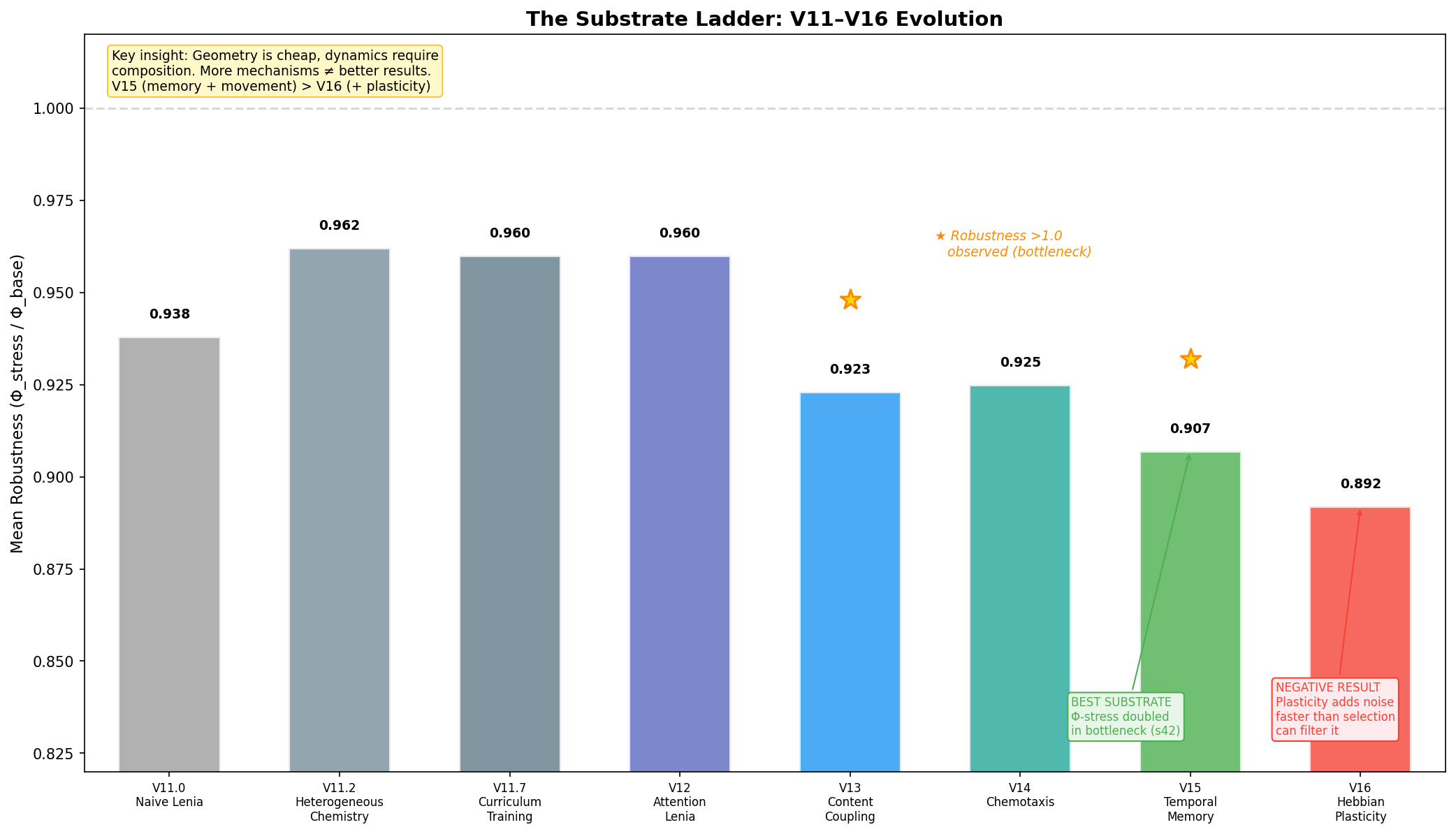
| Version | Mean Robustness | Max Robustness | > 1.0 Cycles | Verdict |
|---|---|---|---|---|
| (content coupling) | 0.923 | 1.052 | 3/90 | Foundation substrate |
| (+ chemotaxis) | ~0.91 | ~0.95 | ~1/90 | Motion evolves |
| (+ memory) | 0.907 | 1.070 | 3/90 | Best dynamics |
| (+ plasticity) | 0.892 | 0.974 | 0/90 | Negative |
| (+ signaling) | 0.892 | 1.125 | 1/90 | Suppressed |
| (boundary) | 0.969 | 1.651 | ~10/90 | Best robustness |